Friday, June 13, 2014
Day 1 - No syllabus
Today is my first day without a syllabus in a year. I had no idea how to spend my time.

Sunday, May 4, 2014
Organizing my digital life #hashtag
I have too much stuff. I think that I am making up for not having the newest and best toys as a child by buying things now as an adult. Worse of all, I refuse to be a fan-boy. So, I have a Windows XP Desktop, a Windows ME Laptop, a Windows 7 Laptop, a Windows 8 Desktop, a Kindle, a Kindle Fire, an iPod, iPad and an iPhone.
Thinking about hardware for a moment...
I have my Windows 8 desktop because I was tired of having to unpack my laptop all of the time. Plus, on the off chance that I break my laptop, I still need a computer. It's the back-up. Furthermore, I want to learn the new software so that there is less of a culture shock when I eventually have to replace my laptop with a device running Windows 9.
I have my Windows 7 laptop because it is my portable office. I use it as my primary computer at school and at work. I used to play games on it, but now it is my e-mailing and document creating device.
I have my Windows ME Laptop because it is the only computer that I own that will run "Lords of the Realm 2".
I have my Windows XP desktop because it reminds me of the idyllic days of my youth.
I have a Kindle because it is the best device for reading books.
I have a Kindle Fire because it was on sale. It's a great device for watching media. It's portable enough that I can carry it around easily.
I have an iPod because I like to listen to music and, in particular, the radio.
I have an iPad because I use it to teach when using Doceri.
I have an iPhone because I wanted a small smartphone with a good camera and I didn't want to learn a new OS (Sorry Android).
I also have five e-mail address, four of which I use on a daily basis. I have an Apple ID, Microsoft Account and a couple of Google accounts. I have a Dropbox, Skydrive and an Amazon Cloud Drive.
Returning to my purpose for writing this document, does anyone have software suggestions for a new Windows 8 PC?
Thinking about hardware for a moment...
I have my Windows 8 desktop because I was tired of having to unpack my laptop all of the time. Plus, on the off chance that I break my laptop, I still need a computer. It's the back-up. Furthermore, I want to learn the new software so that there is less of a culture shock when I eventually have to replace my laptop with a device running Windows 9.
I have my Windows 7 laptop because it is my portable office. I use it as my primary computer at school and at work. I used to play games on it, but now it is my e-mailing and document creating device.
I have my Windows ME Laptop because it is the only computer that I own that will run "Lords of the Realm 2".
I have my Windows XP desktop because it reminds me of the idyllic days of my youth.
I have a Kindle because it is the best device for reading books.
I have a Kindle Fire because it was on sale. It's a great device for watching media. It's portable enough that I can carry it around easily.
I have an iPod because I like to listen to music and, in particular, the radio.
I have an iPad because I use it to teach when using Doceri.
I have an iPhone because I wanted a small smartphone with a good camera and I didn't want to learn a new OS (Sorry Android).
I also have five e-mail address, four of which I use on a daily basis. I have an Apple ID, Microsoft Account and a couple of Google accounts. I have a Dropbox, Skydrive and an Amazon Cloud Drive.
Returning to my purpose for writing this document, does anyone have software suggestions for a new Windows 8 PC?
28 Days Later #hashtag
I miss blogging. I need to go work on my E-Portfolio or plan another week of lessons.
Saturday, March 29, 2014
Never, ever, ever give up #hashtag
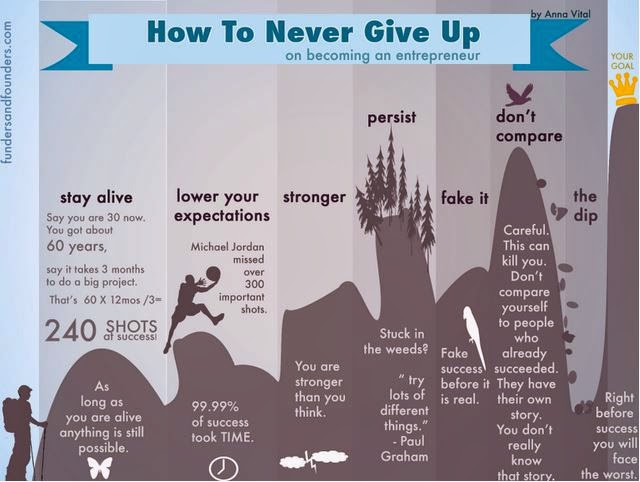 |
| from Lifehack.org |
MP1. Make sense of problems and persevere in solving them.
MP2. Reason abstractly and quantitatively.
MP3. Construct viable arguments and critique the reasoning of others.
MP4. Model with mathematics.
MP5. Use appropriate tools strategically.
MP6. Attend to precision.
MP7 Look for and make use of structure.
MP8 Look for and express regularity in repeated reasoning.
How do you scaffold grit and perseverance?
One more closing thought of pessimism related to the attached image. The first panel left me with an interesting thought. Sixty years of three-month-long attempts could almost mean 239 failures before success. I am not sure if that would be exhilarating or exhausting.
Saturday, March 22, 2014
Break time #hashtag
I came across a funny quip from Ben Franklin. He wrote:
"Tim was so learned, that he could name a horse in nine languages. So ignorant, that he bought a cow to ride on."
As a teacher, it made me think about the nature of education. I have to go write some papers though, so maybe someday I'll get back to this.
The word of the day is mantissa. It's the part of a number that is after the decimal point. So, for 3.18, the "point one eight" is the mantissa. It is a math word that I should have known, but was only introduced to recently.
Back to work.
"Tim was so learned, that he could name a horse in nine languages. So ignorant, that he bought a cow to ride on."
As a teacher, it made me think about the nature of education. I have to go write some papers though, so maybe someday I'll get back to this.
The word of the day is mantissa. It's the part of a number that is after the decimal point. So, for 3.18, the "point one eight" is the mantissa. It is a math word that I should have known, but was only introduced to recently.
Back to work.
Saturday, March 15, 2014
MACUL n'more (ED504)
Traveling to MACUL gave me the first time to travel with my iPad. When Apple announced that they were going to discontinue the the iPad 2, the price dropped by $100 at Best Buy and most other retailers. The barrier to entry was low enough that I purchased one and have begun using Doceri in my classroom. So, while I was moving from session to session, I was able to take notes, store them in iCloud and easily look at them while typing up the blog-post on the good old PC.
The iPad is a great tool for consuming and creating media. You can record and edit photographs, videos and music. Reading and writing text is something that can be done on the iPad easily. The iPad is touted as an educational tool. However, as a computer, you still can't really programs on the iPad. Making apps for the iPad is hard (both because of the programming complexity and closed App Store ecosystem). The reduction in the cost of computer power means that people have more and more computer power available to them. However, fewer and fewer people know how to create computers. Most of the devices we have are polished, but locked down. People rarely tinker with their laptop or smartphone.
On to the stage comes the Raspberry Pi. The Pi is among the world's cheapest computers. It is about the size of a smartphone, features all the connections to hook up to a keyboard, mouse, monitor and network cable and it only costs $35 (there is an older cheaper one for $25). It runs on free, open-source software recorded on an SD card. It is cheap enough so that students can "afford failure." Most of the computers in a school are locked down; not even the teachers are allowed to install software. The Pi gives students a sandbox to play in. It gives the students the opportunity to create software, not just be consumers of software.
Bill Van Loo has begun using the Raspberry Pi in his school with elementary and middle school students. Students in a week-long summer camp program set up their Pi's and started programming code for Minecraft. This sort of creative activity engages students in higher order thinking and problem solving, but it also gives the students a purpose for learning. In his presentation, Bill Van Loo described the process of building a circular tower in Minecraft. Writing the code to do so required revisiting how to convert polar coordinates (in which it is easy to give the equation for a circle) into the rectangular coordinates (which describes the world of Minecraft).
The iPad is a great tool for consuming and creating media. You can record and edit photographs, videos and music. Reading and writing text is something that can be done on the iPad easily. The iPad is touted as an educational tool. However, as a computer, you still can't really programs on the iPad. Making apps for the iPad is hard (both because of the programming complexity and closed App Store ecosystem). The reduction in the cost of computer power means that people have more and more computer power available to them. However, fewer and fewer people know how to create computers. Most of the devices we have are polished, but locked down. People rarely tinker with their laptop or smartphone.
On to the stage comes the Raspberry Pi. The Pi is among the world's cheapest computers. It is about the size of a smartphone, features all the connections to hook up to a keyboard, mouse, monitor and network cable and it only costs $35 (there is an older cheaper one for $25). It runs on free, open-source software recorded on an SD card. It is cheap enough so that students can "afford failure." Most of the computers in a school are locked down; not even the teachers are allowed to install software. The Pi gives students a sandbox to play in. It gives the students the opportunity to create software, not just be consumers of software.
Bill Van Loo has begun using the Raspberry Pi in his school with elementary and middle school students. Students in a week-long summer camp program set up their Pi's and started programming code for Minecraft. This sort of creative activity engages students in higher order thinking and problem solving, but it also gives the students a purpose for learning. In his presentation, Bill Van Loo described the process of building a circular tower in Minecraft. Writing the code to do so required revisiting how to convert polar coordinates (in which it is easy to give the equation for a circle) into the rectangular coordinates (which describes the world of Minecraft).
I was thinking this summer that I might take a vacation somewhere as a reward for graduating. Vacations are expensive, so maybe I will do that next summer. However, I can probably afford to pick up a Raspberry Pi and tinker with it. I'll never teach a programming class, but the Raspberry Pi offers the potential for a club or extra-curricular activity. It also gives me the power to create something more than just an awesome blog, but to create something that actually does something (Like run Doom!).
Returning to my iPad, in another session I came across Explain Everything. It is a video capturing/screen-casting/whiteboard application for the iPad. It allows users to import Documents, PowerPoints, PDFs and a host of other file formats. Then, the users can annotated or mark-up the file before exporting the as images or as an MP4 video. Users can get a similar product for PC's called Jing for free. However, the file format that Jing saves in is difficult to upload and edit. Explain Everything videos can either be immediately uploadable to YouTube or can be loaded into (the free) Microsoft Movie Maker and further edited. Best of all, unlike other videos editing software, Explain Everything only costs $2.99.
Conclusion:
For the cost of parking and the gas to drive out to MACUL, I could buy a computer and start learning how to code. For the cost of a muffin at MACUL, I could download Explain Everything and start flipping my classroom.
Friday, March 14, 2014
Happy Pi-Day! #hashtag
Happy Pi-day.
I scheduled this to post at 1:59 in the morning, so the date and time should read 3/14 1:59AM.
Next year, I could schedule something to post at 3/14/15 9:26AM
Let's look at some pi. . .
3.1415926535897932384626433832795028841971693993751058209749
The World Record for memorizing digits of pi is held by Lu Chao who memorized the first 67,890 digits of pi. So far, I have the first 8 digits. I am working on more. As soon as I get beyond the first 11 digits, I should beat out most scientific calculators. So, after that I can start making up digits to impress people.
Both P and pi are the sixteenth letter of their respective alphabets (English and Greek).
Albert Einstein, Billy Crystal, Michael Caine, and Taylor Hanson were all born on Pi Day. That is probably the only sentence you will ever read in which Albert Einstein and Taylor Hanson appear in the same sentence.
I scheduled this to post at 1:59 in the morning, so the date and time should read 3/14 1:59AM.
Next year, I could schedule something to post at 3/14/15 9:26AM
Let's look at some pi. . .
3.1415926535897932384626433832795028841971693993751058209749
The World Record for memorizing digits of pi is held by Lu Chao who memorized the first 67,890 digits of pi. So far, I have the first 8 digits. I am working on more. As soon as I get beyond the first 11 digits, I should beat out most scientific calculators. So, after that I can start making up digits to impress people.
Both P and pi are the sixteenth letter of their respective alphabets (English and Greek).
Albert Einstein, Billy Crystal, Michael Caine, and Taylor Hanson were all born on Pi Day. That is probably the only sentence you will ever read in which Albert Einstein and Taylor Hanson appear in the same sentence.
Wednesday, March 12, 2014
Tech Joke #hashtag
Teaching and being a grad student leaves little time for blogging, but I did have the opportunity to take this picture the other day.

This is the screen of my iPad. I am using the remote desktop program Doceri on my Windows PC to read an article about Linux using Chrome as a browser. Let's summarize: Apple device, connected to a Microsoft PC, using a Google Browser to read about Linux. It sort of reminds me of Captain Planet. Apple-Microsoft-Google-Linux-Heart with those powers combined, I have the INTERNET!
Friday, February 14, 2014
Thoughts on the Fourteenth #hashtag
It is important to remember the story of Eva Braun (Eva Brown). Hitler had a girlfriend. So, if you are spending Valentine's Day alone, it does not mean you're a bad guy. It just means you're less lovable than Hitler.
That is not entirely true. It could just be a numbers game. According to the CIA, there are 1.01 men for every 1 woman on Earth. If the 7,095,217,980 were to pair off in male-female couples for the holiday there would be an extra 35,299,592 single guys on Valentine's day (I could not find reliable information on how same-sex relationship would affect the number of "extra" men in the world). The population of Canada is about 35 million people.
That is not entirely true. It could just be a numbers game. According to the CIA, there are 1.01 men for every 1 woman on Earth. If the 7,095,217,980 were to pair off in male-female couples for the holiday there would be an extra 35,299,592 single guys on Valentine's day (I could not find reliable information on how same-sex relationship would affect the number of "extra" men in the world). The population of Canada is about 35 million people.
Saturday, January 25, 2014
Comets #hashtag

That got me thinking about the weird comparisons that we make. If something is long, we say that is the length of X football fields. If it's really long, we say it is the length of Y Empire State Buildings, laid on their side. When it's astronomically long, it could wrap around the Earth X times or to the Moon Y times. The volume of something large is measured in multiples of Olympic swimming pools (or fill up a bunch of football stadiums). We use strange units of measurement.
Wednesday, January 22, 2014
Baby, it's cold outside #hashtag

In case you are wondering, there is a 14 hour time difference between Michigan and Siberia. It was just after sunrise in Michigan, which according to the internet, is the coldest portion of the day. Meanwhile, it was well after dark in Siberia (the colder portion of the day, but not necessarily the coldest).
Monday, January 20, 2014
Tiering it up (ED510)
When students are done working on the quiz, or after a given amount of time, we will go over the problems as a group. After going over the problems as a class, students give themselves a score for the test by totaling up the points from each problem that they correctly answered. The point totals correspond to three groups of problems that students work on in the classroom. Students who get none of the problems right would assign themselves to Group A; a student who got all the problems right would assign herself to Group C. Students are encouraged to evaluate their own level of understanding (ahem, metacognition). If a student if confident about his or her understanding of the material, the student is encouraged to ignore the numerical score on the diagnostic quiz and join the group that he or she thinks is most appropriate.
Here is one example selection of homework:Group A: Page 353-354 #16-17, 22-28, 29, 30-31Group B: Page 353-354 #22-27, 29, 31-35Group C: Page 353-354 #22-25, 29-31, 38-42, 51
While at first, it looks like a random sequence of numbers, there is a pattern. Students in Group A focus their attention on definitions and basic calculations.
Take a look at problems 16 and 17:

There are still some problems that all students are expected to complete. Problem #29 requires students to evaluate two examples of student work. All students are expected to work on this problem; it shows up in each problem set.

Problem 51, on the other hand, only shows up in Group C’s problem set. It's a bit challenging.

Challenges
How does tiering work in practice?
Creating the differentiated problem sets is relatively easy. There is a host of available resources that help select problems. The district has a unit planning guide which lays out the standards to be covered from each section of the textbook. The textbook maker provides sample problem sets depending on the desired difficulty. Designing the problem set is just a matter of aggregating information from three or four different resources. It takes time to look over the problems, but it’s doable. A satisfactory solution exists.
The problem is getting students into the right group. Creating differentiated tasks is comparatively simple. While all students pick up the diagnostic quiz when they walk into the room, the actual engagement in the task varies from hour-to-hour and day-to-day. On some days, I would say only half the students attempt the problems before we start going over with as a class. After the quiz, I am not entirely sure that all students engage in a metacognitive conversation and evaluate their knowledge. I think that some of them just work with their group of friends (SHOCKING). Also, I know of at least one student who just counts up the number of problems, ignoring the potential differences in difficulty, and does the problem set with the fewer number of problems.
Another challenge to tiering is that tiering is not a word, at least according to the MS Word dictionary.
Sunday, January 19, 2014
Dalmatians #hashtag

From Star Trek:
Amanda: Spock, does the good of the many outweigh the good of the one? Spock: I would accept that as an axiom. Amanda: Then you stand here alive because of a mistake made by your flawed, feeling, human friends. They have sacrificed their futures because they believed that the good of the one - you - was more important to them. Spock: Humans make illogical decisions. Amanda: They do, indeed.Someday, I need to watch all of the Star Trek movies. With the exception of the latest movie ('Into Darkness"), I have seen pieces of all the movies. The line about the good of the many shows through the original series of movies. I wonder if, as movies get better special effects, if we settle for worse stories. That is not to say that the plots to the original Star Trek movies were solid. I am just not sure that the word "axiom" or discussion about the value of individuals would seep into most movies in the theatres nowadays. I wonder if my students have ever seen a movie that was thought provoking.
My freshman are learning about ATP in biology class. ATP is how the body stores energy in its cells. It consists of a molecule of adenine connected to a molecule of ribose with three phosphate molecules attached somewhere along the time. I was really proud of myself for remembering most of that from my high school biology class.
We learned about Doceri this week. For the first time in my life, I am seriously considering buying an iPad. The guy in Russia who regularly reads my website knows how much I love whiteboards. Doceri might actually be better than a whiteboard. There is not as much writing space as a wall full of whiteboards; I can only have so much information on the screen at one time. However, with the ability to zoom and record, there is an almost unlimited writing space in Doceri if students choose to review the material later on.
The more that I am in the classroom, the more I grow to hate the Doc-Cam/Projector combination. It's hard to keep track of what is actually showing up on the screen ("Can you zoom out?", "Can you move it over to the right?"). You can only fit about half a page on the screen. It's hard to get students to come up and use the doc-cam. I looked into getting a wireless Doc-Cam. However, for the price of a wireless document camera, I could buy an Ipad 2 and a nice laptop or PC (or almost a Mac Mini) and use Doceri and get a much better experience (along with all sorts of functionality when doing something aside from presentations).
Star Trek, ATP, Doceri. Oh yeah, and I wrote about puppies and used a properly placed semi-colon. That is pretty scattered. It's time to go do homework. G'night all. Happy MLK Day tomorrow.
Saturday, January 18, 2014
Why kids don't graduate college #hashtag
I read this article from the Fiscal Times. It's not the most credible source, but it was interesting to consider the reasons behind students failing to graduate from college.
One of the reasons that students fail to graduate from college, in four years, is that they start off behind. They spend their first year of college taking remedial classes which do not count towards graduation. This is something that I hope to prevent (that's my job from here on out).
Another reason that students do not graduate in four years is that they are balancing a work and school schedule. I am of two minds on this. On the one hand, working during college is great, it helps reduce the debt load carried by students. On the other hand, working during college probably isn't worthwhile. In the long run, it probably costs students money.
 I did this calculation a few years back. For almost all students, it does not make sense to have a summer job. They would have saved money, just by looking at the tuition spent, by taking more classes at the community college instead of working for the summer (this is assuming students move 'home' for the summer). As an upperclassman, it makes sense to take summer classes, too. The average starting salary for a college graduate is around $44,000. So, graduating a year early has the potential to be worth $44,000 (at least). It's risky, but for most students, it would probably make sense to rack up a load of student loan debt (and maybe even credit card debt, crazy as that sounds) if it means graduating a year early.
Another unexpected reason that students don't graduate "on time" is that they end up with extra credits. The average college graduate ends up with sixteen extra credits (four or five superfluous classes). This was something that was partially true for me. I graduated with an extra six credits. Another issue for students is scheduling for classes. This has been something that has been true for me as a graduate student. I would have loved to have picked up a political science endorsement, but the two classes that I needed to take were only offered once a year during the morning. So, while it won't affect my graduation, I can imagine the issues surrounding finishing off those rarely offered graduation requirements.
I'll close with a fun fact: Only 1.5% of students graduate college in three years or so. Who are these freaks?
One of the reasons that students fail to graduate from college, in four years, is that they start off behind. They spend their first year of college taking remedial classes which do not count towards graduation. This is something that I hope to prevent (that's my job from here on out).
Another reason that students do not graduate in four years is that they are balancing a work and school schedule. I am of two minds on this. On the one hand, working during college is great, it helps reduce the debt load carried by students. On the other hand, working during college probably isn't worthwhile. In the long run, it probably costs students money.
Another unexpected reason that students don't graduate "on time" is that they end up with extra credits. The average college graduate ends up with sixteen extra credits (four or five superfluous classes). This was something that was partially true for me. I graduated with an extra six credits. Another issue for students is scheduling for classes. This has been something that has been true for me as a graduate student. I would have loved to have picked up a political science endorsement, but the two classes that I needed to take were only offered once a year during the morning. So, while it won't affect my graduation, I can imagine the issues surrounding finishing off those rarely offered graduation requirements.
I'll close with a fun fact: Only 1.5% of students graduate college in three years or so. Who are these freaks?
Saturday, January 11, 2014
New Menus #hashtag

I saw this menu item at a local dining establishment. I wonder if Doug Nussmeier likes meatball subs.
Subscribe to:
Posts (Atom)